System Outages
Are the November outages a coordinated attack?

In one week, Microsoft’s email, the FAA’s air traffic network, Chase’s banking systems, United’s departures and a classified NSA network all went down. Many people online have joined the dots into one story: a cyberattack, a rogue AI, or a plan. A single explanation is satisfying. The record so far shows something more complicated and more worrying: separate failures with separate causes, most of them set off by a change to the system itself (a software fix, an equipment upgrade, a new release), at a time when real attackers are also active. Three recent attacks are confirmed, and none of them is an outage. Two were crimes for money: card-skimming code planted on 178 companies’ websites through Optimizely, and a hijacked page-speed script from DebugBear that drained $2.7 million from Polymarket users; the sites stayed up. The third, hacked supermarket and blood-bank fridges in Europe, France attributes to Iran’s Revolutionary Guards, a military motive. No U.S. outage this month has been attributed to an attack. This page lists every outage people are linking, what caused each one, which attacks were real, and which claims hold up.
These outages look less like an attack than like systems under repair. Microsoft traced its outage to a fix, the FAA to a router installed during an upgrade, Chase to a software release, the NSA to routine maintenance and Apple to an internal update. Security agencies are urging faster patching as newly found flaws pile up, and changes can break things. That is a sign of resilience: it would be far more worrying to see no updates as threats rise. No U.S. outage has been attributed to an attack.
What would change this rating ↓
outages.america2.newsGet America 2.0 in your inbox
Analysis of Russian influence, information warfare and the networks behind them. Free; unsubscribe anytime.
Latest reports
New reporting from major outlets and official sources, listed as it appears. Our monitoring adds headlines from major outlets automatically. "Checked" means our software fetched the full report and confirmed it supports its headline. "Reviewed" means an editor checked it against its source. "Auto" items have not been checked yet. Tap a label for our note. None of this is an endorsement. Our assessment is the rating above.
- What’s likely behind all of these tech outages (CNN)
reviewed ▾
Our note: CNN analysis: each company or agency has named its own cause, lawmakers of both parties want a briefing, and the administration says there is no crisis.An editor checked this report against its source. (2026-11-17) - NSA dealing with communications outage (CBS News)
auto ▾
Not checked yet. Listed automatically because it comes from a major outlet or official source. - Apple works to restore services after outage caused by internal update (Reuters)
auto ▾
Not checked yet. Listed automatically because it comes from a major outlet or official source. - NSA says internal systems outage caused by ‘scheduled routine maintenance’ (Politico)
reviewed ▾
An editor checked this report against its source. (2026-11-17) - NSA attributes US network outage to routine ‘maintenance’ activities (Al Jazeera)
reviewed ▾
An editor checked this report against its source. (2026-11-17) - A classified NSA network is down. What happened? (USA Today)
reviewed ▾
An editor checked this report against its source. (2026-11-17) - Classified communications network at the National Security Agency goes down, defense official says (AP News)
reviewed ▾
An editor checked this report against its source. (2026-11-17) - As string of tech outages raises alarms, Trump says everything is "fine" (Reuters)
reviewed ▾
An editor checked this report against its source. (2026-11-17) - Apple Works to Restore Systems After Internal Update Causes Outage (Bloomberg)
reviewed ▾
Our note: Apple says an internal update caused the outages and that they did not stem from a cyberattack.An editor checked this report against its source. (2026-11-17) - Classified NSA network went down, but no indication it was an attack, sources say (NBC News)
reviewed ▾
An editor checked this report against its source. (2026-11-17)
What would change this assessment
The question is whether the outages are connected attacks. That will be settled by investigators (the FBI, CISA, the FAA and DOT, the NTSB) or by the companies’ own post-incident reports, not by timing.
Would move the rating up
- not seenAn official attack finding: the FBI, CISA or an affected company says any of the U.S. outages was a cyberattack or sabotage.
- not seenA credible claim of responsibility: a known group claims an outage and offers proof that investigators take seriously.
Would keep it low
- seenSeparate, named causes: Microsoft, the FAA and Chase have each named a cause of their own, and none involves an intruder (see the outage list below).
- seenOfficials rule out attacks: DHS Secretary Markwayne Mullin said he is “98 percent” certain no cyberattack is behind the outages (Newsweek). An FBI official said the Chase outage showed “no indication of malicious or external cyber activity” (Fox Business).
Why AI has made fixing software more urgent
AI is not causing these outages. It is changing the conditions that every large organization works under, and that is pushing them to change their systems faster.
- Flaws are cheap to find. AI models can now find previously unknown software flaws for as little as $4 each, work that once took skilled researchers weeks (ZDNET). Defenders and attackers both have that power.
- Attackers move before fixes exist. Google’s Mandiant estimates that the average time to exploit a flaw is now minus seven days, meaning attacks routinely begin before a patch is released. Exploited flaws are the most common way attackers get in, accounting for 32% of the intrusions Mandiant investigated (Google Cloud).
- Break-ins are being automated. The FBI warned on Nov. 13 that hackers are using ARTEX, an AI tool, to automate intrusions (The Record). Australia’s cyber agency told organizations to expect “more frequent security updates and shorter time to act” (ASD).
- Big organizations have the most to lose. Banks, airlines, cloud providers and government agencies run thousands of systems, many of them reachable from the internet, and hold money and data that attackers want. A data breach in the U.S. cost an average of $10.22 million in 2025, a record (SecurityWeek, citing IBM). Against that, the risk of a few hours of downtime from a rushed fix is the smaller one.
- Speed has a price. Less time to test each change means more changes go wrong. The outages are a visible cost of organizations doing what security agencies are asking. It would be far more worrying if they were not updating at all.
- The agency built to explain this has been cut back. CISA, the federal agency that warns organizations about software flaws and helps them respond, has lost roughly a third of its staff since early 2025 through buyouts and budget cuts, had no permanent director as of May, and has taken a back seat in the White House’s response to AI-driven hacking (Axios). We have found no federal statement tying this week’s outages to the rush to patch. The president’s first comment, relayed by Fox News on Nov. 13, blamed the ground stop on “old broken stuff”; the FAA traced it to a new router installed during an upgrade (Newsweek). On Nov. 17 he said of the outages, “Things like that happen. It’s fine,” and a White House spokeswoman said there was “no crisis”; Sen. Josh Hawley, a Republican, said that if it was all a coincidence, “it’s like the greatest coincidence in the history of the world” (Reuters). Vice President JD Vance told Fox News on Nov. 16 that people need not build bunkers or stock up, then added, “But you have to be prepared for everything.” Lawmakers of both parties, including House Democratic leader Hakeem Jeffries and Republican Sen. James Lankford, have asked the administration to explain the outages (CNN).
The bigger pattern: everyone is patching and rebuilding at once
The strongest thread running through this week is not an attacker. It is the pressure on every large organization to change its systems faster than usual, and to take them off the open internet where it can.
- The volume of fixes is enormous. Microsoft’s November security update alone fixed 1,094 flaws, one of them already being exploited (SecurityWeek). For why this is happening now, see why AI has made fixing software more urgent.
- Organizations are pulling systems off the internet. When a critical flaw turned up in PHP, software used by most of the world’s websites, last month, Britain’s cyber agency urged site managers to “unplug” until it was fixed, and Wikipedia, BBC News and several government sites went offline as a precaution (The Telegraph). Rebuilding systems so fewer machines face the public internet is sound security, but each rebuild is a large change, and large changes are where outages come from.
- Deadlines are shorter. In June, CISA replaced fixed patching schedules for federal agencies with risk-based deadlines, which put the most urgency on flaws in internet-facing systems (SC Media).
- The outages fit that pattern. Microsoft’s failure traced to a server fix, the FAA’s to a router installed during an equipment upgrade, Chase’s to a new software release, and the NSA network’s, officials say, to a software update (The Wall Street Journal, via ForexFactory). After the ground stop, the FAA paused installing new routers (MSN). None of this means every outage was an upgrade gone wrong. It means a week of many simultaneous changes is a week of more failures, with or without an attacker.
What experts are saying
We include specialists who stick to what the evidence shows. None of them sees a coordinated attack. Several point to the same pressure: a flood of newly found security flaws is forcing faster software changes, and faster changes break things.
- Nicole Perlroth, former New York Times cybersecurity reporter: what she is hearing “does not contradict the messaging that most of this is the result of screwy updates.” She points to an explosion of AI-discovered flaws and “enormous pressure to compress patching windows and accelerate software updates, increasing the likelihood these fixes break things in unexpected, cascading ways” (X).
- Australian Signals Directorate (Australia’s cyber agency): “Vulnerabilities are moving quickly. Organisations should prepare for more frequent security updates and shorter time to act,” and should “reduce internet exposure” (ASD).
- Peter Wildeford, AI Policy Network: his “more normal guess” is that AI-discovered flaws mean companies “are having to do a lot of patches and upgrades, probably faster than usual. Such upgrades can sometimes go wrong, causing outages” (X).
- Jacob Ward, CNN contributor and tech journalist: “Where most people see conspiracy, I almost always encounter incompetence.” The common thread is aging systems, he said: “now when we just try and do something like a routine upgrade, we wind up skunking the whole system” (CNN).
Every outage people are linking
Newest first. “Stated cause” is what the operator or officials have said on the record; we note where it is still preliminary.
| Outage | What failed, and the stated cause | Attack? |
|---|---|---|
| Malicious code on 178 companies’ websites, via Optimizely (Nov. 16) | Attackers exploited a flaw in Optimizely’s web-testing service to add malicious JavaScript to customers’ sites, including the BBC, CNN, Zoom, HSBC and Equifax. The code tried to steal card details and swap crypto wallet addresses; the sites stayed up. Optimizely says it fixed the flaw and removed the code (SecurityWeek). | Yes A crime for money (card and crypto theft), not an outage; the sites stayed up. Nothing links it to the other failures. |
| Apple: iCloud sign-in, App Store, Apple Music and stores (Nov. 17) | Apple’s system status page listed the App Store, Apple Music and iCloud sign-in as “slow or unavailable” from about 11:45 a.m. ET, and AppleCare purchases on devices as unavailable (Apple). Its developer status page showed problems with App Store Connect and Xcode Cloud from about the same time (Apple Developer). Downdetector reports for Apple Pay and iCloud spiked around noon ET; Apple had not responded to requests for comment (USA Today). Store employees said their own systems were down too (PCMag). Apple said its systems were coming back “after an internal update caused some outages this morning,” and that the problems did not stem from a cyberattack. The outage also hit employee sign-in, internal tools and stores worldwide (Bloomberg). | No Apple: an internal update; Apple says it was not a cyberattack. |
| NSA’s internal classified network (Nov. 17) | NSA Net, which agency employees use to share classified information internally, went down, according to six people familiar with the matter; the agency staggered staff arrivals. The NSA did not comment at first (CNN). U.S. officials later told The Wall Street Journal the network was offline because of a software update, not a cyberattack (The Wall Street Journal, via ForexFactory). A U.S. official told CBS News the network suffered a “temporary degradation during scheduled routine maintenance,” and two officials said there was no evidence of a cyberattack (CBS News). A person familiar with the incident said the NSA was “simply updating its software to patch the system” and that the network would be offline only temporarily (Alex Ward, WSJ). The NSA later confirmed a “temporary degradation” of some networks during scheduled maintenance (Politico). | No Officials cite a software update; sources told CNN there was “no evidence of a cyberattack.” |
| Charles Schwab website (Nov. 17) | Customers reported login errors shortly after markets opened, about 9:55 a.m. ET, with more than 1,000 Downdetector reports by 10 a.m. Schwab had not confirmed an outage or given a cause (IBTimes). Schwab also had user-reported outages in August (Hindustan Times). | No cause given |
| Navy Federal Credit Union app (Nov. 16–17, overnight) | Members reported trouble with the app and website from about 11 p.m. ET; Navy Federal said its “technical team is actively working to resolve the issue.” American Express users separately reported login problems. Neither company tied the two together or gave a cause (IBTimes). Navy Federal also had a confirmed outage in August (Hindustan Times). | No cause given |
| Los Angeles County Superior Court civil reservation system (Nov. 17) | The court said its civil court reservation system was “currently unavailable due to vendor technical issues” (LA Superior Court). | None reported The court cites a vendor problem. |
| Gmail, Marriott, Apple iCloud, Toyota online services, National Weather Service data feed (Nov. 17) | Users reported problems on Downdetector, which counts user complaints, not confirmed failures. None of the companies had confirmed an outage or a cause at last check. The National Weather Service’s data feed for weather apps also had problems, with several hundred user reports (The Mirror). | Unconfirmed |
| Chase, and transfers at other banks (Nov. 16) | Chase customers had trouble with online banking and payments from about mid-morning until transactions were “posting normally” around 6:30 p.m. ET. An FBI official said it was traced to a software release Chase rolled out that morning. Other banks were hit only where Chase was a party to a transaction, and Chase said the problem was “not systemic” (Fox Business). | No Chase: “a technical issue, not cyber-related.” |
| United Airlines departures (Nov. 16) | A “widespread system outage” delayed some United departures for about an hour, starting shortly after 5 p.m. ET. United called it “a technology issue” and has not said more (Gizmodo). | No United: “no indication that this was a cybersecurity-related issue.” |
| Amtrak booking website (Nov. 13) | During the FAA ground stop, Amtrak’s website returned errors. Amtrak pointed to “increased demand for travel across our network” as stranded flyers looked for trains; it worked normally the next day (WJLA). | None reported A demand spike caused by the ground stop, by Amtrak’s account. |
| Amazon Web Services, US-East region (Nov. 15) | Sign-in, account signups and network connections failed for about three hours before AWS restored service. AWS did not attribute it to an attack (Cybersecurity News). | None reported |
| Verizon wireless 911 calls, Pennsylvania (Nov. 15) | A Verizon outage disrupted wireless 911 calls across several Northeastern and Central Pennsylvania counties for much of the day; texting still worked (WBRE/WYOU). No cause given. | No cause given |
| 911 service, Eugene, Ore. (Nov. 13) | A 911 outage hit about 250,000 residents. Police arrested a man on suspicion of stealing the copper wire that caused it (KEZI). | No Suspected wire theft, a local crime. |
| AT&T app and some network service (Nov. 13) | Users could not log in to the app and reported partial network outages; service was back by early afternoon (Android Authority). No cause given. | No cause given |
| National Weather Service radar (Nov. 13): did not happen | Reports of a nationwide weather-radar outage were wrong. The Weather Service said “there is no radar outage” and that outdated web pages had been circulating (Yahoo Weather). | No outage |
| FAA nationwide ground stop (Nov. 13) | The FAA stopped all U.S. departures from 3:54 to 8:15 p.m. ET after communications failed at air route traffic control centers. Transportation Secretary Sean Duffy said contractor L3Harris was replacing old copper lines with fiber at a remote site, and the router there began flooding the network. Officials are still working out whether it was contractor error or faulty equipment (Al Jazeera). The FBI has taken control of the router, CNN reported (Gizmodo). Our closed FAA Outage tracker has the full record. | No Duffy: “we don’t believe this was cyber at all.” |
| Microsoft 365: Outlook, Teams (Nov. 12–13) | Email and other Microsoft 365 services failed worldwide for about a day. Microsoft executive Charles Lamanna said a “latent defect” in a July fix for its network gateway servers was triggered when a surge in traffic hit at a time of reduced capacity; servers that came back were overwhelmed again, which slowed recovery (ABC News). | No Microsoft says it was not a cyberattack. |
| Apple iCloud, Find My and Apple sign-in (Nov. 10) | Apple confirmed outages in iCloud Mail, Calendar, Contacts, Photos and sign-in for several hours, then said all were resolved. No cause given (9to5Mac). | No cause given |
| Polymarket wallets drained via a page-speed script (Oct. 29) | Attackers hijacked the domain of DebugBear, a UK website-performance service, and replaced its page-speed script with code that drained crypto wallets. Polymarket halted trading for about an hour, said “one of our third party providers was compromised,” and promised to repay users (BleepingComputer). | Yes A crime for money (crypto theft) through a supplier’s script, not an outage. Unrelated to the November failures. |
| Supermarket and blood-bank fridges in Europe (Oct. 11 onward) | Hackers took over refrigeration controls at about 700 French supermarkets in October, then at more than 100 sites across Europe in November, including fridges at French blood banks. France’s foreign minister has blamed a cyber unit of Iran’s Revolutionary Guards; Belgium’s ministers disagree on whether the evidence is strong enough (NBC News). The equipment maker said most of the systems hit were older products that no longer received security updates (AP). | Yes The one real attack campaign on this list, in Europe. Nothing links it to the U.S. outages. |
Also mentioned online but not confirmed as outages: a Cox Internet outage (named in a widely shared Nov. 16 post; we found no report of it in news searches) and Gmail problems (user reports on Downdetector only; Google listed no disruption). We’ll add any that are confirmed.
What is actually known
- The government has not explained the week as a whole. No agency has given one public account of all the outages. The NSA said on Nov. 17 that some internal systems were degraded during “scheduled routine maintenance” and that “mission-critical capabilities remain fully operational,” but did not say which systems (Politico). The clearest federal statement on cyberattacks was DHS Secretary Mullin saying on Fox News that he is “98 percent” certain there was none. Nicole Perlroth, a former New York Times cybersecurity reporter, wrote that the country needs “far more system-wide reassurance than this administration is offering,” and called the failure to communicate “a system wide failure” (X). Conspiracy theories grow fastest where official explanations are missing.
- No outage has been attributed to an attack. The confirmed attacks were different in kind. The Optimizely and DebugBear incidents were thefts by criminals after card numbers and crypto, and the websites involved kept working. The European fridge attacks, which France blames on Iran’s Revolutionary Guards, are the only ones with a state or wartime motive, and they hit refrigeration controls, not the services Americans lost this month.
- Each outage has its own cause. Microsoft traced its failure to a latent bug in a July server fix; the FAA to a router installed during a cable upgrade; Chase to a software release it rolled out the morning of the outage. No investigator or company has linked any two of them.
- Most began with a change to the system. A fix, an upgrade or a new release preceded the Microsoft, FAA and Chase failures. Changes like these are routine, and they are also the most common way large systems break. A second pattern shows in Europe: the hacked fridges ran software that was no longer being updated.
- Officials say no attack. DHS Secretary Mullin said on Fox News that he is “98 percent” certain no cyberattack is behind the outages: “No one is out there taking claims for it, we’re not seeing the traffic.” In the same interview he relayed an unnamed tech figure’s theory that “super intelligence” was responsible, which no evidence supports (Newsweek).
- The money fight. After the ground stop, Duffy asked Congress for $50 billion to rebuild air traffic control: “new hardware, new software, new telecommunication” (The Hill). Democrats want to know how earlier funding was spent (AP).
- Simple answers are satisfying; this is not simple. The week’s failures are complex and have several causes: aging systems, upgrades and fixes made under pressure, traffic surges, and a threat environment in which real attackers are moving faster. One master explanation feels better than five separate ones, but the evidence points to five separate ones.
- Real attacks do happen. On Nov. 16, attackers used a flaw in Optimizely, a web-testing service, to plant card-skimming code on 178 companies’ websites (SecurityWeek). Europe’s fridge hacks are an officially attributed campaign, and attackers routinely use outages as bait for phishing. On Nov. 13 the FBI warned that criminals and state-backed hackers are using ARTEX, an open-source tool that lets AI models run intrusions “at machine speed,” in some cases reaching privileged access in under three hours (The Record). The FBI has not linked it to any of the outages on this page. Ruling out an attack in these cases does not mean systems are safe.
What we could not check: the full post-incident findings. Microsoft, the FAA, Chase and United have given preliminary accounts; none has published a complete root-cause report, and the NSA has said nothing.
Claims in circulation
The most-shared claims about the outages, and what the record shows. Tap a row for the record; the link icon copies a direct link.
No evidenceThe outages are a coordinated cyberattack on the U.S.
The companies and officials who have named causes describe internal failures: a latent bug, a router during an upgrade, a software release. DHS Secretary Mullin put his certainty that there was no cyberattack at “98 percent” (Newsweek), and an FBI official found no sign of malicious activity at Chase (Fox Business). The claim rests on timing: several failures in one week.
Where it came from: social-media posts after the ground stop, led by retired Lt. Gen. Michael Flynn (see “Who is amplifying it”).
No evidenceAI, or a rogue “super intelligence,” is causing the outages.
Mullin relayed the idea on Fox News from an unnamed tech-industry source, saying it “kind of makes sense to me,” but offered no evidence (Newsweek). Microsoft said its outage was not “caused by AI tooling,” and the FAA’s administrator said there was “zero evidence of anything AI-related” in the ground stop. AI-driven hacking is real: the FBI warned on Nov. 13 about ARTEX, a tool that automates intrusions (The Record). But no investigator has tied it, or any AI, to these outages.
Where it came from: Mullin’s Nov. 16 Fox News interview; earlier questions from public figures (“Is it AI?”).
No evidenceBuilding AI into every system is what is breaking them.
None of the causes named so far involves an AI tool: Microsoft traced its outage to a server fix, the FAA to a router installed during an upgrade, Chase to a software release and the NSA to routine maintenance. AI’s real role is indirect. It is finding software flaws faster, so organizations are patching faster, and more changes mean more failures (see why AI has made fixing software more urgent).
Where it came from: Nov. 17 replies on X saying AI being built into every system is “the problem.”
No evidenceThe outages are part of Project 2025.
None of the stated causes involves the government or Project 2025: Microsoft traced its outage to a server fix, the FAA to a router installed during an upgrade, Chase to its own software release and the NSA to a software update. The Heritage Foundation’s Mandate for Leadership does propose splitting air traffic control from the FAA (pp. 632–634), a change it says would “require legislation,” and no such law has passed (Mandate for Leadership). It does not cover private companies such as Microsoft, Chase or United, and nothing in the record suggests any outage was caused on purpose to advance it (see our FAA Outage tracker).
Where it came from: a widely shared Nov. 17 post warning followers of Project 2025 that “the power grid is next” (17,594 likes), and earlier posts calling the ground stop the plan’s first step.
No evidenceThe outages line up with the Genesis Mission’s November deadlines.
No Genesis Mission deadline falls in November 2026. The program, created by a Nov. 24, 2025 executive order, is a Department of Energy effort to build an AI platform for scientific research. The order sets deadlines of 60, 90, 120, 240 and 270 days, which fell between January and late August 2026 (Federal Register). The program concerns research computing at national laboratories, not the email, banking, airline or air-traffic systems that failed, and every stated cause this month is unrelated to it.
Where it came from: a Nov. 17 post by the commentator Drey (@thedreydossier) saying the outage timeline was “lining up with the Genesis Missions November deadlines” (1,626 likes, about 50,000 views; see amplifiers).
No evidenceThe outages were staged to justify privatizing air traffic control.
The administration is using the ground stop to argue for money: Duffy wants $50 billion to modernize the system (The Hill). That is a funding request, not privatization, and nothing in the record suggests any outage was caused on purpose. On Project 2025, see the row above.
Where it came from: X posts asking whether the ground stop was a “manufactured emergency to privatize our air traffic control system,” and a widely shared Nov. 17 post warning that under Project 2025 “the power grid is next.” Project 2025 says nothing about causing outages.
No evidenceThe outages are cover for secretly moving money, people or data.
Each outage has a named, separate cause, and none of the operators reports missing funds, records or aircraft. The claim is phrased as a question (“some people are saying”), which lets it spread without a source.
Where it came from: a Nov. 16 post by former Rep. Marjorie Taylor Greene.
FalseThe Nov. 17 emergency alert test is the start of a 90-day blackout.
DHS said FEMA would run “a routine, federally mandated test” of the Emergency Alert System at about 2:20 p.m. ET on Nov. 17, lasting about a minute on TV and radio, with “no action” required (DHS). Earlier in November, fake AI videos of President Trump announcing a “90-day blackout” circulated to sell crypto tokens (Snopes), and local outlets fielded questions tying that rumor to the test date (USA Today Network).
Where it came from: fake “90-day blackout” videos, and posts treating any nationwide alert as a signal of something bigger.
Common questions
- Weren’t websites hit by malicious code? Yes. On Nov. 16, attackers used a flaw in Optimizely, a service many companies use to test web pages, to add malicious JavaScript to 178 organizations’ sites. That was a real attack, but it stole data rather than taking anything offline, and no investigator has linked it to the Microsoft, FAA, bank or airline outages (SecurityWeek).
- Why did the FBI take the FAA router? Investigators take the device at the center of a major failure so they can examine it, whatever the cause turns out to be. Taking it is not a finding of sabotage. The FBI has not announced what it found, and officials have said they do not believe the ground stop was a cyberattack (Al Jazeera).
- How could Microsoft make such a basic mistake? By Microsoft’s account, the bug was not new. A fix from July carried a “latent defect” that only appeared when a surge of traffic hit at a time when some servers were already offline (ABC News). Flaws that show up only under a rare combination of conditions are a common cause of large outages, and testing often misses them.
- Is a ransomware gang behind the Chase outage? A ransomware group has listed Visa and JPMorgan Chase on its leak site and set a deadline (Cybernews). Such listings are the gang’s own claim and are often exaggerated. Chase traced its Nov. 16 outage to its own software release, and an FBI official found no sign of malicious activity (Fox Business).
By the numbers: is this week unusual?
If the outages were one coordinated event, this week should stand out from the record. Measured against past years, it does not. One outage was very large; the rest were ordinary in size. Public interest is high, but no higher than after single outages in 2025. What is new is the story linking them.
Download this panel as an image to share →
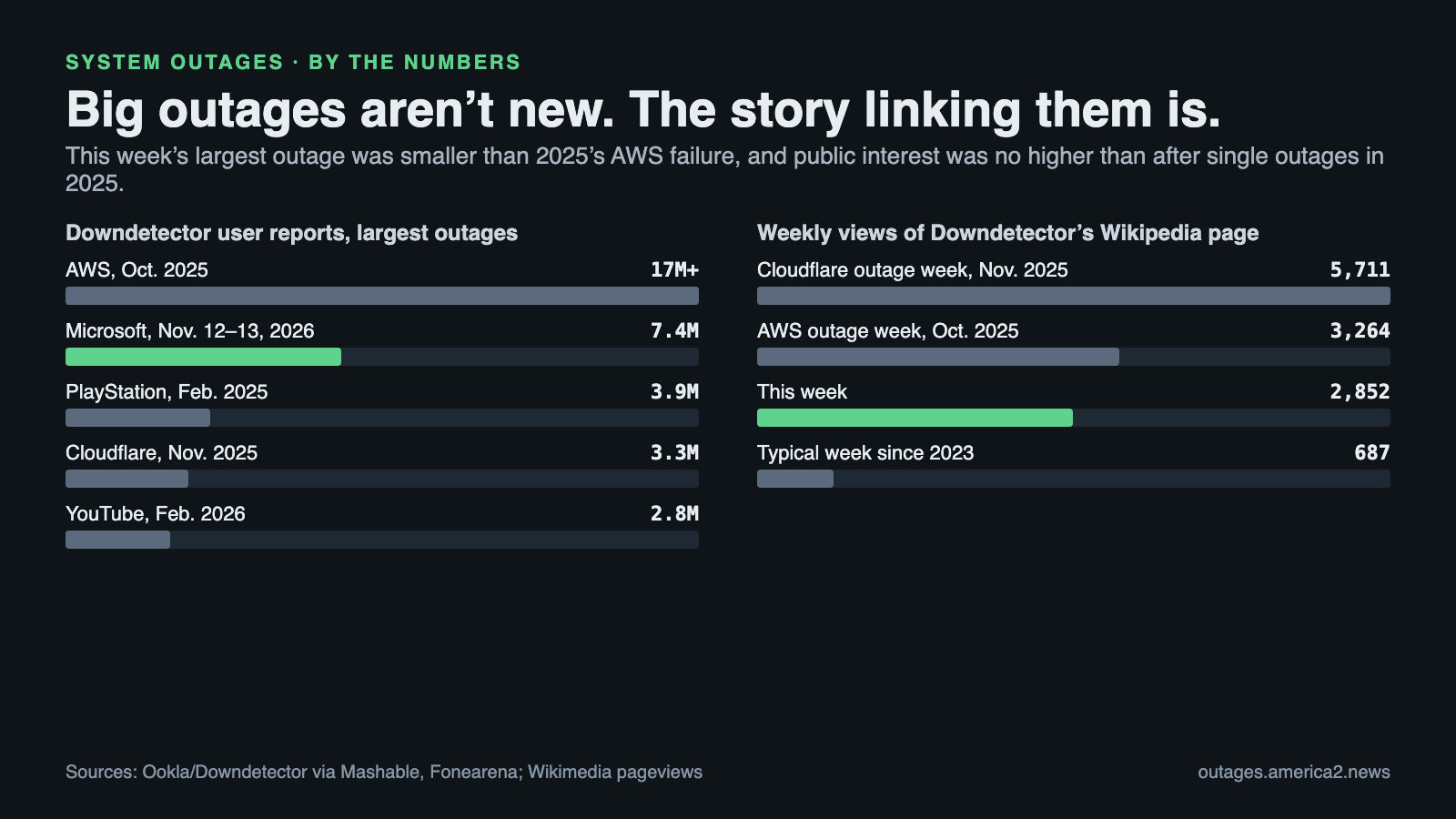
Biggest outages by user reports to Downdetector
Microsoft’s outage was the largest of 2026 so far, with 7.4 million reports (Mashable, citing Ookla). The 2025 Amazon Web Services outage drew more than twice as many, and nobody called it a coordinated attack (Ookla’s 2025 report, via Fonearena). Schwab’s Nov. 17 login trouble, by comparison, drew about 1,000 reports.
People checking whether things are down
Weekly views of Downdetector’s Wikipedia article, a rough measure of public interest in outages (Wikimedia). This week ran about four times a typical week and ranks fifth of 202 weeks since January 2023. Single outages in 2024 and 2025 drew more.
- The global internet had a quiet week. Cloudflare Radar, which logs major internet outages worldwide, recorded one in the past seven days (the Microsoft disruption), against a median of three a week since January 2023 (Cloudflare Radar). Radar tracks network-level failures, mostly outside the U.S., so it does not count bank or airline app problems.
- User reports spread to services that are working. Downdetector counts complaints, not confirmed failures. During the Microsoft outage it showed problems at Amazon Web Services, which AWS disputed (Mashable). When people expect things to break, they report more of them.
- What this cannot show. Downdetector sells its full history only to paying businesses, so we cannot count every outage week by week. These measures are rough, and we will update them as better data appears.
Why it feels connected
- Simple stories spread faster than complicated ones. “It’s all one attack” is easier to repeat than “five unrelated failures in a changing threat environment.”
- We have seen this before. In late 2024, residents of New Jersey and nearby states reported more than 5,000 “mystery drones.” The FBI later found they were small planes, helicopters, hobby drones, law-enforcement aircraft and stars (GovTech). Once people were primed to look, ordinary things in the sky became evidence. Outages work the same way: each new glitch seems to confirm the story (see also America 2.0).
- Clusters happen by chance. Large systems fail all the time; most weeks, the failures just don’t land on things everyone uses at once. When three do, people look for a single hand behind them. A retired FBI agent told a Rhode Island TV station: “These are not connected events. They just happen to fall on the calendar close to one another” (WJAR).
- Once an idea is in the air, every new glitch seems to fit it. Reports of a Cox outage and Gmail problems spread this week without any confirmed outage behind them, and routine login trouble at Schwab and Navy Federal, both of which had similar outages in August, was quickly added to the list. We saw the same contagion in the 2024 New Jersey drone sightings, when people primed to see drones reported ordinary aircraft (America 2.0).
- Confusion is its own security risk. Each false alarm makes the next real warning easier to dismiss, and it hands real attackers a ready-made smokescreen. When officials leave gaps, rumor fills them, and a public that has stopped trusting explanations is harder to warn when a real attack comes.
Who is amplifying it
Public figures with large audiences who have promoted attack, AI or cover-up theories about the outages without evidence, from across the political spectrum. Like counts as of Nov. 17. Listing a post here records what was said; it does not mean the person shares the other views on this list.
| Who | What they said | Reach |
|---|---|---|
| Michael Flynn, retired Army lieutenant general and former national security adviser | Nov. 16: the outages are “probably a cyber attack.” His list began with a Cox Internet outage that we could not find in any news report (X). | 13,159 likes |
| Marjorie Taylor Greene, former member of Congress | Nov. 16: “Is it AI?” (X, 13,874 likes, 916,000 views). Nov. 17: an outage “is a good time to delete info … to move money. Chaos keeps everyone distracted” (X). | 16,307 likes (Nov. 17 post) |
| Josh Hawley, U.S. senator (R-Mo.) | Nov. 17: if the outages are “all a coincidence, it’s like the greatest coincidence in the history of the world” (MSN). | Clip: 6,559 likes |
| @RabbiJeffx, a left-leaning X account | Nov. 17: “For those of you following along with Project 2025, the power grid is next” (X). | 17,594 likes |
| Drey (@thedreydossier), commentator with about 82,000 followers | Nov. 17: said the outage timeline was “lining up with the Genesis Missions November deadlines” (X). The executive order sets no deadline in November 2026 (see the claim row). The account later pointed to Energy Department upgrade plans for its own research computing, which do not cover the banks, airlines or email services that failed. | 1,626 likes, 50,000 views |
| Bark (@barkmeta), crypto influencer | Nov. 16: “First the banks. Then the internet. Then the power grid. Then the Great Reset…” (X). | 9,703 likes |
| Markwayne Mullin, Secretary of Homeland Security | Nov. 16, on Fox News: relayed an unnamed tech figure’s theory that “super intelligence” caused the outages, while saying he was 98 percent sure there was no cyberattack (Newsweek). | National TV |
| Mike Adams (“Health Ranger”), supplement seller and Natural News founder | Nov. 14: issued an “emergency alert” to followers calling the “multiple cascading failures” part of a pattern (X). | 12,405 likes |
| @ProudSocialist, an anonymous left-wing account | Nov. 14: “Did Trump and Duffy plan this whole thing to get a $50 billion” payout, quoting an unnamed pilot who called the ground stop “a big farce” (X). | 13,250 likes |
| Don Winslow, novelist | Nov. 16: tied a reported U.S. intelligence warning about an Iranian dirty-bomb plot to the outages: “Know when you are being fed and manipulated” (X). | 5,060 likes |
| Lara Logan, former CBS correspondent | Nov. 14: “cyber attacks can be used as cover to mask movement for a catastrophic event” (X). | 4,589 likes |
| Laura Loomer, activist | Nov. 16: listed the outages alongside Iranian threats: “We are not being told the truth about what is happening” (X). | 4,416 likes |
What to watch next
- The FAA’s and the FBI’s findings on the router at the remote site, and whether a final root cause names contractor error or a faulty device.
- Microsoft’s final post-incident report, and Chase’s account of what its software release changed.
- Any NSA statement on what took NSA Net down.
- Congress’s response to the $50 billion air traffic control request.
- The Nov. 17 Emergency Alert System test, and any claims built on it.
- EU sanctions over the fridge attacks, which France expects to be agreed Dec. 14.
Timeline
- Oct 11Hackers take over refrigeration controls at hundreds of French supermarkets (AP).
- Oct 29Attackers hijack a page-speed script to drain about $2.7 million from Polymarket users (BleepingComputer).
- Nov 9France blames Iran’s Revolutionary Guards for the fridge attacks (NBC News).
- Nov 13FBI warns that hackers are using ARTEX, an AI tool that automates intrusions (The Record).
- Nov 12Microsoft 365 outage begins; email is down for about a day (ABC News).
- Nov 13FAA nationwide ground stop, 3:54 to 8:15 p.m. ET; Amtrak’s website struggles as travelers switch to trains (Al Jazeera).
- Nov 14Duffy traces the ground stop to a router during a copper-to-fiber upgrade and asks for $50 billion (The Hill).
- Nov 16Attackers use a flaw in Optimizely to plant card-skimming code on 178 companies’ websites (SecurityWeek).
- Nov 16Chase outage, traced to a software release; United delays departures for about an hour; Mullin floats an AI theory on Fox News (Fox Business; Newsweek).
- Nov 17NSA’s internal classified network goes down; no evidence of a cyberattack, sources say (CNN).
Key sources
- ABC News: Microsoft identifies issues leading to global Outlook outage
- Al Jazeera: What forced the US to ground all planes? A router switch
- Fox Business: JPMorgan Chase systems recovering after nationwide outage
- CNN: Highly classified US national security network goes down
- Newsweek: DHS says AI could be responsible for outages
- America 2.0: FAA Outage tracker (closed Nov. 14)